
The formal retrieve reveals training quality faster than any other obedience exercise. From my judging position, I can identify within seconds whether a dog learned to retrieve with understanding or merely learned to react to thrown objects. The dog who races out, snatches the dumbbell, and races back often mouths the article, drops it early, or sits crooked - problems that accumulate deductions across multiple retrieve exercises. The dog who retrieves with precision demonstrates training depth that extends beyond the retrieve itself.
Understanding the Retrieve Chain
A competition retrieve consists of distinct behaviors chained together: the send, the go-out, the pickup, the return, the front sit with hold, the release, and the finish. Each link in this chain can earn or lose points. Handlers who train "retrieve" as a single behavior rather than a sequence of connected behaviors struggle with precision that competition demands.
Open Retrieve Exercises
The Formal Hold
Before teaching retrieves, teach the hold. Your dog must understand how to hold an object calmly and release it only on command. This foundation prevents the mouthing, chomping, and premature dropping that costs points in competition.
Start with your dog in sit position. Present the dumbbell and encourage them to take it. The moment they hold it calmly - even briefly - mark and reward. Gradually extend hold duration before adding any release cue. A dog who understands "hold this until I say otherwise" has the foundation for clean retrieves.
Common Hold Problems
Mouthing - adjusting grip repeatedly - stems from unclear criteria about what holding means. The dog who learned to grab and drop never learned that holding has duration. Address this by rewarding only still holds, even if brief initially.
Anticipating release - dropping before commanded - happens when dogs learn that the release always follows the hold quickly. Vary your timing. Sometimes release immediately; sometimes wait thirty seconds. Unpredictability teaches patience.
The Hold Foundation
Spend two to four weeks on hold training before adding retrieves. Dogs who rush through hold training struggle later. A solid hold makes every retrieve exercise easier. A weak hold creates problems that multiply across exercises and levels.
Teaching the Pickup
After your dog holds reliably, teach the pickup - taking an object from the ground or a surface. This differs from taking an object from your hand. Many dogs comfortable with hand presentations struggle with ground pickups.
Start with the dumbbell on a low platform, then gradually lower it. Work toward the ground pickup in small increments. Rushing this progression creates dogs who poke at the dumbbell or grab it awkwardly.
Clean Pickups
Judges watch how your dog picks up the dumbbell. A clean pickup involves approaching the dumbbell, lowering the head, grasping the bar firmly, and lifting smoothly. Dogs who bat the dumbbell, mouth at it repeatedly, or pick it up by the bell rather than the bar create poor impressions and lose points.
Train for a specific grip location. The dumbbell should be held by the bar, centered in the mouth. Dogs who grip off-center or grab the bells struggle with carrying and delivering the dumbbell cleanly.
Building the Go-Out and Return
Once hold and pickup are reliable, add the go-out - sending your dog away from you to retrieve. Start with very short distances. The dumbbell sits only a few feet away. Your dog goes out, picks up, returns, and delivers. Success at short distance builds the pattern that extends to full ring distance.
The return should be direct. Dogs who detour, circle, or approach at angles lose points. Train returns specifically by rewarding the straightest path back to you. Some handlers use guide barriers initially to shape direct returns.
Retrieve Deductions
The Front Sit and Delivery
Your dog returns and sits directly in front of you, close but not crowding, holding the dumbbell until you take it. This front sit follows the same criteria as recall fronts - straight, close, and attentive.
Train the front sit with the dumbbell separately from the front sit on recalls. Some dogs sit beautifully on recalls but struggle with the added complexity of holding an object. Practice fronts with held objects until the hold becomes irrelevant to the sit quality.
The Release
On command, your dog releases the dumbbell cleanly into your hand. Not before you reach for it. Not after you have pulled it from their mouth. The release should be a distinct behavior - the dog opens their mouth when commanded, and the dumbbell transfers smoothly.
Dogs who anticipate release drop the dumbbell as your hand approaches. Dogs who resist release make judges wonder about training methods. A clean release happens on your cue, not based on your hand position.
Retrieve Over High Jump
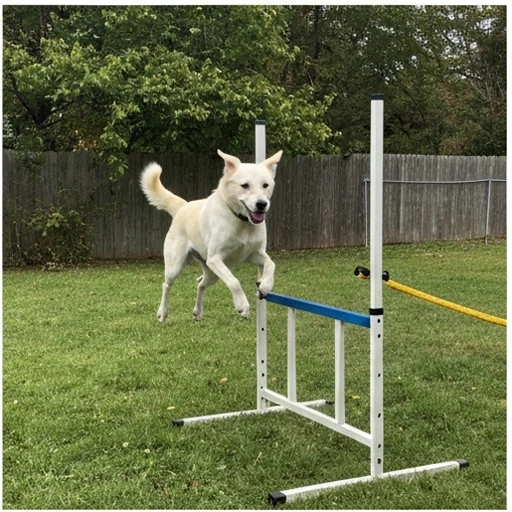
The retrieve over high jump combines retrieve skills with jumping. You throw the dumbbell over the jump, send your dog, they jump out, retrieve, jump back, and deliver. The jumping adds physical demands and new potential errors.
Jump Training
Train jumping separately before combining it with retrieves. Your dog should jump confidently at their competition height before adding the retrieve component. Dogs unsure about jumping focus on the jump rather than the retrieve, creating sloppy pickups or returns.
The return jump matters as much as the outbound jump. Some dogs jump out cleanly but attempt to go around on the return. Train both directions specifically. Many handlers use barriers initially to prevent going around while the dog learns that jumping both ways is required.
Combining Exercises
Add complexity gradually. Master retrieves on flat before adding jumps. Master jumping without retrieves before combining them. Dogs who learn combined exercises before mastering components often show confusion that persists into competition. Each skill should be solid independently before integration.
Directed Retrieve Preparation
Utility directed retrieve adds a directional component to retrieve skills. You indicate which of three gloves to retrieve, and your dog must take direction and retrieve the correct one. The retrieve mechanics transfer from Open, but the directional understanding requires additional training.
Begin directional training while perfecting Open retrieves. Your dog should learn to look where you indicate rather than scanning for objects independently. This conceptual shift - following direction rather than finding objects - distinguishes directed retrieve from simple retrieve work. The complete Utility preparation guide explains how directed retrieve fits into the overall Utility training plan.
Scent Article Retrieves
Utility scent discrimination uses retrieve skills within a scent-finding framework. Your dog locates your scented article among unscented articles, then retrieves it. The retrieve mechanics should be automatic so your dog can focus on the scent work. See my detailed guide on scent discrimination for the complete methodology.
Building Retrieve Enthusiasm
Competitive retrieves should look enthusiastic, not mechanical. The dog who races out with obvious enjoyment, picks up crisply, and returns briskly creates better impressions than the dog who plods through the exercise accurately but without engagement.
Build enthusiasm through play-based training. Retrieving should be rewarding in itself, not just a way to earn treats. Dogs who love retrieving maintain motivation through long competition careers. Dogs who retrieve only for external rewards eventually show declining enthusiasm.
Maintaining Drive
Avoid drilling retrieves to the point of boredom. Quality matters more than quantity. Five enthusiastic retrieves beat twenty mechanical ones. End sessions while your dog still wants more rather than when they are tired of the exercise.
Vary your retrieve training. Different locations, different dumbbells, different contexts. The dog who retrieves enthusiastically everywhere has generalized the behavior. The dog who retrieves only in familiar settings may show less drive in novel competition environments.
The Complete Retrieve
Never accept partial retrieves in training. Every retrieve should include all components: go-out, pickup, return, front sit, hold, release, and finish. Practicing incomplete retrieves teaches incomplete behaviors. The habits you build in training appear in competition exactly as you trained them.
Competition Preparation
Before entering Open, your retrieves should be reliable in multiple locations with distractions present. Practice run-throughs that simulate ring conditions. Have strangers throw your dumbbell occasionally - in competition, stewards may move or touch it between exercises. Our ring preparation guide covers how to simulate competition conditions effectively.
Know your dumbbell. Competition regulations specify acceptable dumbbell dimensions based on your dog's size. Practice only with a dumbbell meeting these specifications. Dogs trained with different dumbbells sometimes show hesitation with their competition dumbbell.